
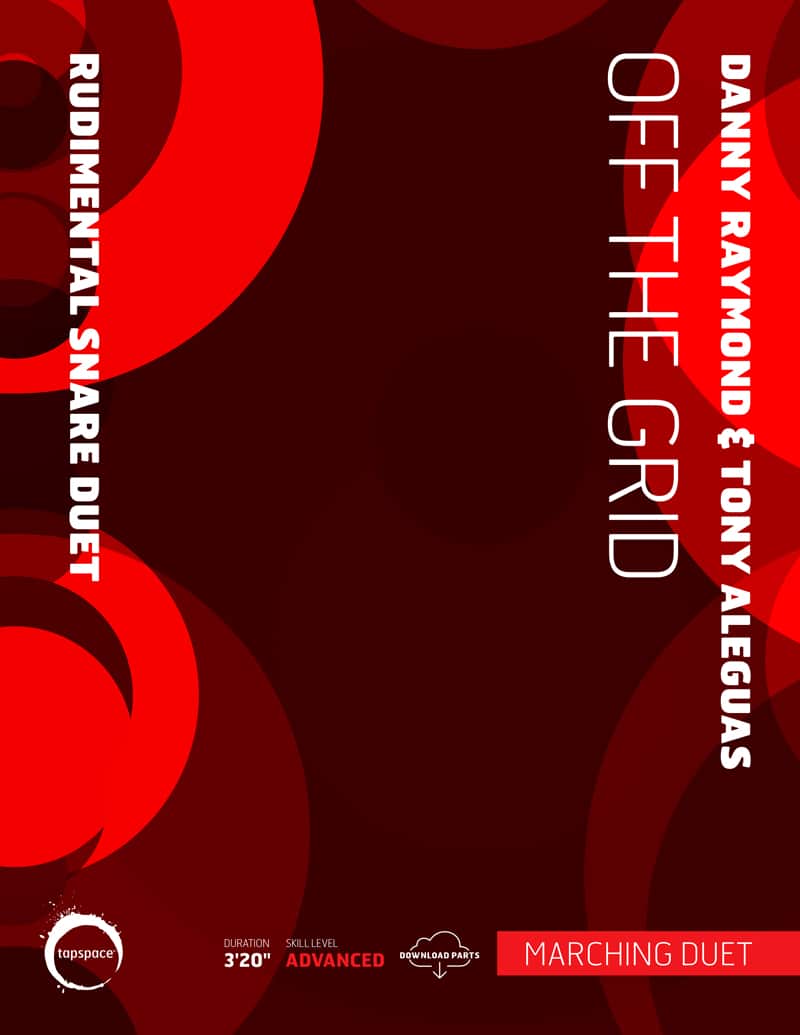
Off the Grid
duet for rudimental snare drums
Off the Grid by Danny Raymond and Tony Aleguas is a funky and challenging duet for advanced snare drummers. The piece merges a groove-oriented feel with popular flam and hybrid rudiments presented in various permutations derived from a grid* format. The call-and-response nature of the piece provides performers with a 20-bar solo that they can play as written or explore their own musical ideas. Raymond and Aleguas have included many visual instructions in the piece, but performers are encouraged to make the piece their own by adding their favorite backsticking, twirls, and other stick tricks. No matter the choice of snare drums, improvised or transcribed solos, or visual elements, staying on or off the grid will test players of all levels!
*”Gridding” rudiments is a method many rudimental drummers use in order to explore a rudiment in various capacities to completely master the control of said rudiment. Many drummers will choose to alter one or more component(s) of the rudiment in a sequential manner to develop technique, timing, and tone at the same time.
Off the Grid ships as a printed, professionally bound score and includes individual parts in PDF format for printing or tablet viewing.
- 2 rudimental snare drums
Reviews
Only logged in customers who have purchased this product may leave a review.








Hannah Weaver –
This snare drum duet is perfect for any drum corps enthusiast looking to add flair to a concert program. Heavily influenced by marching snare drum style, with back sticking, stick flips, other stick flashes, and double stops, the piece is both musically and visually engaging. Composers Danny Raymond and Tony Aleguas dedicated this duet to Tom Float, the teacher and drum corps instructor credited with popularizing the concept of gridding.
The piece begins with call-and-response sections between the two players, with the occasional unison line cutting in emphatically. The energy builds to the first climactic point with stick flips and twirls — a nod to DCI and marching-band style. This marks the end of the first section, and the piece transitions into extended solo sections.
Each player has 20 bars of solo material while the other plays light background grooves. These solos incorporate visual elements (tossing sticks from one hand to the other, twirling between matched and traditional grip, half and full stick flips, etc.) as well as impressive technical passages (complex flam patterns, triple-bounce sextuples, fast diddle rudiments, etc.). While the performers can certainly stick to the written solos, Raymond and Aleguas also encourage improvisation during these sections.
The duet concludes with a return to opening material — more call-and-response interspersed with unison patterns. The dramatic finale is reached after an extended crescendo and a final nod to drumline writing with flashy thirty-second-note splits between the players.
The marching elements incorporated in this solo shouldn’t be a deterrent to students without a background in that area. Raymond and Aleguas included a useful preface with an explanation of “gridding” in a marching context, examples of gridding within the piece, and a few exercises demonstrating the basic concept. This duet could be a fun and energetic opening/closing piece for a concert, and the gear required is easily transportable, ideal for run-out performances or clinics at schools.